
by Jacob Wellnitz, Liberty In Action Board Member
Inspired by the federal Department of Government Efficiency (DOGE), Kerr County needs a local fiscal revolution.
DOGE’s mandate is clear: cut bloat, enforce accountability, and ensure government doesn’t extract more from citizens than absolutely necessary.
Here in Kerr, that means confronting a budgeting system that has amassed $28,480,687 in cumulative governmental fund surpluses from FYE (Fiscal Year End) 2018 to FYE 2024, according to audited Annual Comprehensive Financial Reports (ACFRs) on the county auditor’s website.
These surpluses aren’t flukes, they’re symptoms of two things; failure to recognize and correct the overbudgeting trend and incremental budgeting, where last year’s inflated figures become this year’s baseline. Together these lead to consistent over-collection of property taxes. While government-wide net position grew by over $70 million (for details, see our previous article), the fund-level view reveals the core issue: $28.5 million in net fund balance increases, with unassigned General Fund reserves ballooning by $15,684,466. This excess, built on local revenues exceeding needs, represents over-taxation. Funds were pulled from Kerr families that could have lowered bills or funded priorities like flood warning systems. It is notable that this situation has existed for years without being corrected.
Critics, like The Kerr County Lead’s editorial, have dismissed the $70 million net position growth as a “lie” or “misrepresentation,” claiming it contains grants and confuses accounting. These attacks deflect from the real problem: sustained over-taxation under current leadership, forcing residents to fund excesses beyond operational needs. The chart below exposes exactly how the Judge’s budget has manufactured these surpluses through years of deliberate over-budgeting.
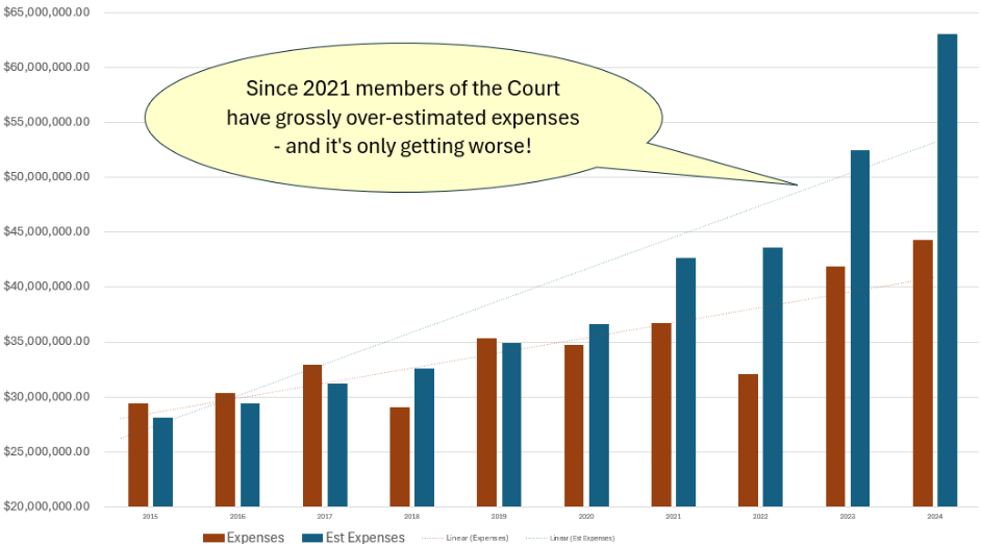
Figure 1: The blue bars represent estimated expenses in the budget, while the red show actual expenses per audited County financials.
Net Position vs. Fund Balances: The Audited Truth
We haven’t equated government-wide net position with cash surplus. Net position includes capitalized assets like roads and buildings, depreciated over time. This still shows revenues outpacing expenses year after year. For precision, we must examine fund-level statements, the “Statement of Revenues, Expenditures, and Changes in Fund Balances” for governmental funds (pages ~25-27 in recent ACFRs). These provide a cash-flow-like view for Fiscal Years Ended September 30 (FYE):
- FYE 2018: -$2,029,836
- FYE 2019: $6,736,284
- FYE 2020: $4,322,042
- FYE 2021: $4,074,841
- FYE 2022: -$407,965
- FYE 2023: $8,569,385
- FYE 2024: $7,215,936
Cumulative: $28,480,687—revenues exceeding expenditures, including capital outlays.
What about grants? Intergovernmental revenues ($6,642,831 in FYE 2024) are restricted, but isolating revenues derived from within the county, (e.g., $49,021,456 in FYE 2024) shows the pattern holds: local collections cover operations while surpluses grow.
The General Fund, funding core services, tells the story. Unassigned balance (available cash-like resources):
- FYE 2018: $9,400,328
- FYE 2024: $25,084,794
- Growth: $15,684,466 (167% increase)
With FYE 2024 expenditures at $39,502,649 (~$3.29 million/month), this equals 7.6 months of operations—far beyond the Government Finance Officers Association’s 2-month recommendation (~$6.6 million) or a conservative 3 months (~$9.9 million). Excess: ~$15.2 million, or ~$282 per resident ($1,128 for a family of four, based on 53,900 residents in 2025). As a percentage: 63.5% of expenditures. This isn’t caution; it’s hoarding funded by over-taxation.
Budget growth amplifies the issue. FYE 2013 expenditures: $26,221,417. FYE 2026 adopted budget: $63,529,798 (142% rise), vs. 8.3% population growth (49,781 in 2013 to 53,900 in 2025)¹ and 36-40% cumulative inflation.² Incremental budgeting drives this bloat.
Budget vs. actual? FYE 2024 budgeted General Fund: $45,922,081; actual: $39,502,649; underspend: ~$6.42 million, fueling surpluses. This ratchet—over-budget, over-collect, under-spend—mirrors federal waste DOGE targets.
Responding to “declining reserves” claims: Audited growth from $9.4 million to $25.1 million debunks scarcity. Rate cuts? Valuations rise, so collections do too—which means effective over-taxation. Structural deficits? Reserves wouldn’t have expanded if real.
Frédéric Bastiat called excess extraction “legal plunder.” Here, it’s structural.
DOGE-Inspired Reforms: A Path to Efficiency
DOGE demands fixes, not excuses. Apply it to Kerr:
- Zero-Based and Target-Based Budgeting: Require every Kerr County department to justify every single dollar from the ground up each budget cycle, or strictly cap spending at proven needs only. This will end the irresponsible 142% spending bloat that has far outpaced inflation and population growth. Moving to full zero-based budgeting for the entire county at once would be challenging, so we recommend a practical phased approach that rotates through departments over several years.
- Waste Audits and Reallocation: Scrutinize $28.5 million surpluses for redundancies (e.g., pay raises amid reserves); redirect to infrastructure without hikes, or lower property tax rates below no-new-revenue levels.
- Reserve Caps and Rebates: Limit to 2-3 months; rebate excesses to taxpayers via lowered property tax rates.
- Transparency Overhaul: A reserve balance should be a real account. Currently the reserve appears comingled with other funds. Breaking it out into a county “emergency fund” would make more sense and provide taxpayers real insight into tax policy. Real-time dashboards for oversight could be implemented. It would be worth spending a bit of the surplus to build a system that taxpayers could monitor.
Under Judge Rob Kelly, surpluses piled up without change. His endorsed successor, Tom Jones, has supported this method of financing the County.
The Structural Divide: DOGE Slate vs. Status Quo
Voters face a clear choice in the March 3 Republican Primary: DOGE reformers vs. status-quo defenders enabling over-taxation.
DOGE Slate (efficiency-focused, anti-over-taxation):
- James Stewart (County Judge): Advocates zero-based/target-based budgeting to reset baselines, curb growth, align taxes with needs.
- Clayson Lambert (Pct. 1 Commissioner): Calls for instituting a “Continuous Improvement Program” to provide annual reviews of departmental efficiency.
- Rich Paces (Pct. 2 Commissioner): Pushes “no new tax” rates, acknowledges high reserves, seeks drawdowns.
- Randy Murphy (Pct. 4 Commissioner): Supports zero-based resets to limit surpluses, protect taxpayers. Calls for elimination of incremental budgeting.
- Carl Berthold (County Clerk): A Marine veteran who emphasizes efficient, transparent operations managed like a CEO, applying disciplined fiscal responsibility to eliminate waste and prioritize taxpayer value.
Status-Quo Slate (no reforms, sustaining over-taxation):
- Tom Jones (County Judge): Defends “no fat” budgets, votes for effective increases, ignores resets.
- Wayne Uecker (Pct. 1 Commissioner): Notes over-budgeting but avoids pledges, uses scare tactics against cuts.
- Brenda Hughes (Pct. 1 Commissioner): Voted for post-flood tax hikes via loopholes, prioritizes revenue over restraint.
- Mike Allen (Pct. 2 Commissioner): Vague on reforms, dodges specifics on surpluses.
-
Bubba Walters (Pct. 4 Commissioner): Close ally of Tom Jones and retiring commissioner Don Harris; continues the incremental budgeting that produced $28.5 million in surpluses without zero-based resets or taxpayer rebates.
-
Denise Vela (County Clerk): Maintains costs without challenging frameworks, enables over-collection.
For more on status-quo “pick-pocketing” via hikes and spending, see Pick Pockets: Mailer Footnotes.

Public funds are a trust, not a piggy bank. Seven years of surpluses prove over-taxation.
DOGE locally means reform.
Polls open now through March 3.
Choose efficiency.Vote the DOGE Slate.
¹ U.S. Census Bureau / FRED: Kerr County population 49,781 (2013); 53,900 (July 1, 2024 official estimate, used for 2025 projection). Growth: 8.3%.
² U.S. Bureau of Labor Statistics CPI-U: Cumulative inflation 2013–2026 ≈ 39% (within 36-40% range cited).
All financial figures above are directly from Kerr County’s audited ACFRs (FYE Sept 30, 2018–2024) and the Adopted FY2025-2026 Budget (Sept 8, 2025), available at kerrcountytx.gov/auditor.